AI & Technology

EU AI Act + Global AI Regulation in 2026 — What Thai Businesses Need to Know

The EU AI Act reaches full enforcement in August 2026. Thai businesses serving EU customers or using AI from international providers must prepare for a four-tier risk classification system, transparency requirements, and bias auditing — before it is too late.

20 Mar 202612 min
AI RegulationEU AI ActAI GovernanceCompliancePDPADigital Transformation

EU AI Act + Global AI Regulation in 2026 — What Thai Businesses Need to Know

If you are a Thai business executive deploying AI — whether it is a chatbot, a resume screening system, AI embedded in your ERP, or generative AI tools your team uses daily — 2026 is the year you can no longer treat "AI regulation" as someone else's problem.

The most comprehensive AI legislation in the world is reaching full enforcement, and its impact extends far beyond European borders.


EU AI Act — The World's First Comprehensive AI Law

The EU AI Act was officially signed into law in August 2024. It is the first legislation anywhere in the world to establish a complete regulatory framework for AI — from development and deployment to governance and enforcement.

The cornerstone of this law is a Risk-Based Approach, meaning AI systems posing higher risks face stricter requirements, while low-risk applications remain largely unregulated.


Enforcement Timeline — The Deadlines Keep Coming

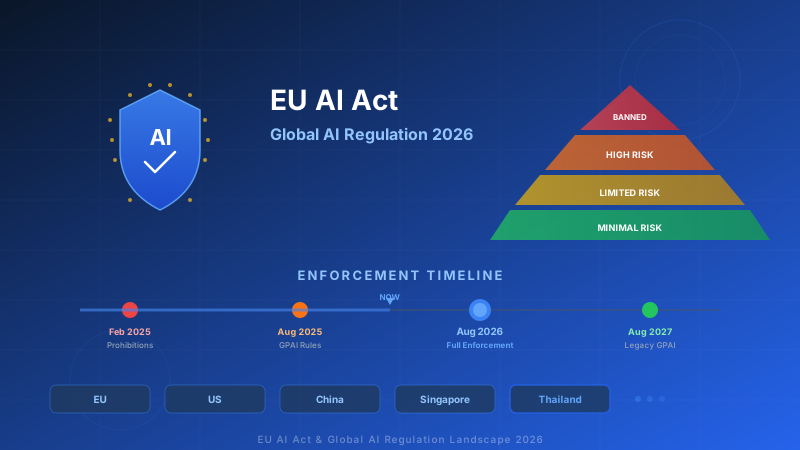
The law does not take effect all at once. Instead, it rolls out in waves:

February 2025 — Prohibited AI Practices Banned

AI systems classified as "unacceptable risk" were completely banned as of February 2, 2025. This phase also introduced AI literacy requirements for developers and deployers.

August 2025 — GPAI Obligations Begin

Starting August 2, 2025, providers of General-Purpose AI Models (GPAI) placed on the market after this date must comply with new obligations. This includes large-scale models like GPT, Claude, and Gemini. Models deemed to pose systemic risks must notify the EU AI Office.

August 2026 — Full Enforcement

This is the critical deadline — August 2, 2026. Requirements for high-risk AI systems take full effect, along with the European Commission's enforcement powers, including the ability to impose fines.

August 2027 — Legacy GPAI Deadline

GPAI models placed on the market before August 2025 must achieve compliance by August 2, 2027.


The Four-Tier Risk Classification — The Heart of the EU AI Act

The EU AI Act categorizes AI systems into four risk levels, each determining the degree of regulatory oversight:

Tier 1: Unacceptable Risk — Banned Entirely

AI systems that contradict fundamental EU values are prohibited outright:

  • Social scoring systems that evaluate citizens' behavior
  • AI using subliminal or manipulative techniques to distort behavior
  • Real-time biometric identification in public spaces (with narrow exceptions for security)
  • Predictive policing based on personal profiling data

Tier 2: High Risk — Strict Compliance Required

AI used in areas with significant impact on people's lives must undergo conformity assessments before deployment:

  • Critical infrastructure — Energy management, traffic control, water supply systems
  • Education and training — AI that determines grades or screens students
  • Employment — AI that screens resumes, evaluates performance, or decides terminations
  • Financial services — AI credit scoring, fraud detection
  • Justice and law enforcement — AI assisting in court decisions or risk assessments

Requirements for high-risk AI include: risk assessment, data quality standards, technical documentation, transparency, human oversight, and accuracy benchmarks.

Tier 3: Limited Risk — Disclosure Required

AI systems that interact with users must inform them they are engaging with AI:

  • Chatbots must disclose they are AI-powered
  • AI-generated content (such as deepfakes) must be labeled
  • AI-driven decisions must be explainable

Tier 4: Minimal Risk — No Additional Requirements

Most everyday AI applications fall here — spam filters, AI in games, product recommendation engines. No additional regulatory obligations apply.


How Does This Affect Thai Businesses?

"We are not in Europe — why should we care?" This is a question we hear often. The answer is clear:

Extraterritorial Reach

Like GDPR before it, the EU AI Act applies outside EU borders in these scenarios:

  • Thai businesses serving EU customers — If you use AI in products or services sold to EU customers, you must comply
  • Thai businesses using AI output in Europe — If your AI's output is used within the EU, you fall under this law
  • Thai businesses in EU supply chains — If your European clients must comply with the EU AI Act, they will require their entire supplier chain to comply as well

AI in ERP and Business Systems

A blind spot many organizations overlook is AI embedded in ERP and business software:

  • AI in HR systems — Resume screening with AI may qualify as High Risk
  • AI in credit systems — AI-based credit scoring requires bias auditing
  • AI in supply chain — Demand forecasting that affects employment or critical infrastructure may fall under High Risk
  • Customer service chatbots — Must disclose they are AI under Limited Risk requirements

Choosing an ERP system with built-in AI compliance is becoming critically important from 2026 onward.


Global AI Regulation — It Is Not Just the EU

United States — Pro-Innovation Approach

The US has taken a distinctly different path from the EU:

  • January 2025 — Executive Order 14179 revoked the 2023 Executive Order on AI safety, shifting policy toward promoting innovation and US AI leadership
  • December 2025 — A new Executive Order challenged state-level AI laws that might impede innovation, directing the Attorney General to establish an AI Litigation Task Force
  • The US approach favors self-regulation over binding legislation

Despite the lighter touch, businesses seeking access to both US and EU markets will need to meet the stricter standard — which is the EU AI Act.
China — Strict Control With Rapid Deployment

China pursues a distinctive approach — tight regulation paired with aggressive AI adoption:

  • August 2025 — The State Council issued the AI Plus Action Plan, targeting 70% AI penetration in key sectors by 2027 and 90% by 2030
  • October 2025 — The Cybersecurity Law was amended to include AI provisions for the first time in national law, effective January 1, 2026
  • China aims for a fully AI-powered economy by 2035

Singapore — Principles-Based Approach

Singapore has chosen a flexible, principles-based framework:

  • FEAT Principles — The Monetary Authority of Singapore (MAS) established Fairness, Ethics, Accountability, and Transparency principles for AI in financial services
  • Model AI Governance Framework — A voluntary governance framework covering generative AI
  • Veritas Framework — Assessment tools for evaluating compliance with FEAT principles, developed in collaboration with industry
  • Singapore emphasizes balancing innovation with governance — a model worth studying for Thailand

Thailand — Building Its Own AI Governance Framework

Thailand is not standing still:

National AI Strategy (2022-2027)

The Ministry of Digital Economy and Society (MDES) and the Office of the National Digital Economy and Society Commission (ONDE) are driving the National AI Strategy to promote responsible AI adoption.

ETDA AI Governance Guidelines

The Electronic Transactions Development Agency (ETDA) plays a key role:

  • October 2024 — MDES and ETDA published "Guidelines for the Application of Generative AI with Good Governance for Organizations"
  • Development of a draft AI law using a risk-based model aligned with international standards including the EU AI Act, ISO/IEC 42001, and the NIST AI Risk Management Framework
  • The AI Governance Center (AIGC) under ETDA oversees implementation, research, and organizational guidance on AI adoption

Draft AI Act

A public hearing was held in June 2025 to consolidate two draft AI instruments into a single law. Greater clarity is expected throughout 2026.


What Thai Businesses Must Prepare Starting Today

1. AI Inventory — Know Where You Use AI

Before complying with any regulation, you must audit where AI is used across your organization — both AI you developed in-house and AI embedded in software you use (ERP, CRM, HR systems).

2. Risk Classification — Assess Your Risk Level

Classify every AI system against the EU AI Act's risk tiers:

  • Which systems qualify as High Risk?
  • Which require disclosure under Limited Risk?
  • Could any fall under Unacceptable Risk?

3. AI Transparency — Build Openness Into Your Systems

  • Label AI at every customer-facing touchpoint
  • Chatbots must disclose they are AI
  • AI-generated content must be clearly identified
  • AI decisions must be explainable (Explainability)

4. Bias Auditing — Check for Unfairness

AI used in decisions affecting people (hiring, credit, services) requires:

  • Bias testing on training data
  • Continuous fairness metrics monitoring
  • Appeal mechanisms for affected individuals

5. Documentation — Get Your Records in Order

Essential documentation includes:

  • Technical documentation of AI systems
  • Risk assessment records
  • Organizational AI governance policy
  • Incident response plan for AI failures

6. Human Oversight — Maintain Human Control

High-risk AI must include:

  • Human-in-the-loop intervention mechanisms
  • Emergency kill switches
  • Clear escalation procedures

Penalties — More Than Just Warnings

The EU AI Act imposes severe penalties:

  • Prohibited AI — Fines up to EUR 35 million or 7% of global annual revenue
  • Non-compliant high-risk AI — Fines up to EUR 15 million or 3% of global annual revenue
  • Providing false information — Fines up to EUR 7.5 million or 1% of global annual revenue

Reduced rates apply to SMEs and startups, but the amounts remain substantial.


AI Compliance Is Not a Cost — It Is a Competitive Advantage

Organizations that prepare early gain clear benefits:

  • Credibility — Greater trust from international clients and partners
  • Market access — Confident entry into the EU market
  • Legal risk reduction — Protection against both the EU AI Act and Thailand's forthcoming AI legislation
  • Better AI — Compliance processes force quality checks, often leading to more accurate and fairer AI systems

How Enersys Helps Thai Businesses Navigate AI Regulation

At Enersys, we work with Thai businesses of all sizes to deploy AI responsibly:

  • AI Readiness Assessment — Evaluate your organization's preparedness for domestic and international AI legislation
  • AI Governance Framework — Design a governance structure tailored to your organization
  • ERP + AI Integration — Deploy ERP systems with built-in AI compliance, reducing risk from the source
  • AI Bias Audit & Monitoring — Continuous fairness testing and monitoring of AI systems
  • Training & Awareness — Team training on AI Literacy as required by the EU AI Act

AI regulation is coming — the question is not whether to prepare, but whether you will prepare in time.

Ready to consult with experts? Contact Enersys today


References

Related Articles

Agentic AI 2026 — เมื่อ AI ไม่ใช่แค่ตอบคำถาม แต่ทำงานแทนได้จริง

จาก Chatbot สู่ AI Agent ที่ลงมือทำ — ออกใบแจ้งหนี้ อนุมัติค่าใช้จ่าย สั่งซื้อสินค้า ตอบลูกค้าครบจบในตั๋วเดียว ตลาด $9B+ โต 8 เท่าใน 2 ปี Gartner คาดปี 2026 แอปองค์กร 40% จะมี AI Agent ในตัว

AI + ERP ปี 2026 — เมื่อ ERP คิดเองได้ และ Odoo ก็ทำได้แล้ว

ปี 2026 AI ไม่ใช่ add-on ของ ERP อีกต่อไป — SAP Joule มี 2,100 AI skills, Oracle ปล่อย 600+ AI agents, NetSuite เตรียม Autonomous Close และ Odoo ฝัง AI Chatbot ที่แปลงภาษาธรรมชาติเป็นคำตอบธุรกิจ พร้อม Smart Drafting และ Agentic AI ที่ทำงานแทนคนได้จริง

AEO vs GEO — เจาะลึกสองกลยุทธ์ที่ตัดสินว่า AI จะ "เห็น" หรือ "ข้าม" เว็บไซต์คุณ

Web Mentions สัมพันธ์กับ AI Citations สูงกว่า Backlinks ถึง 3 เท่า — คู่มือเชิงลึก AEO vs GEO พร้อมวิธีตรวจสอบ 60 จุดและปรับเว็บไซต์ให้ AI ค้นเจอ

"Empowering Innovation,
Transforming Futures."

Contact us to make your project a reality.